

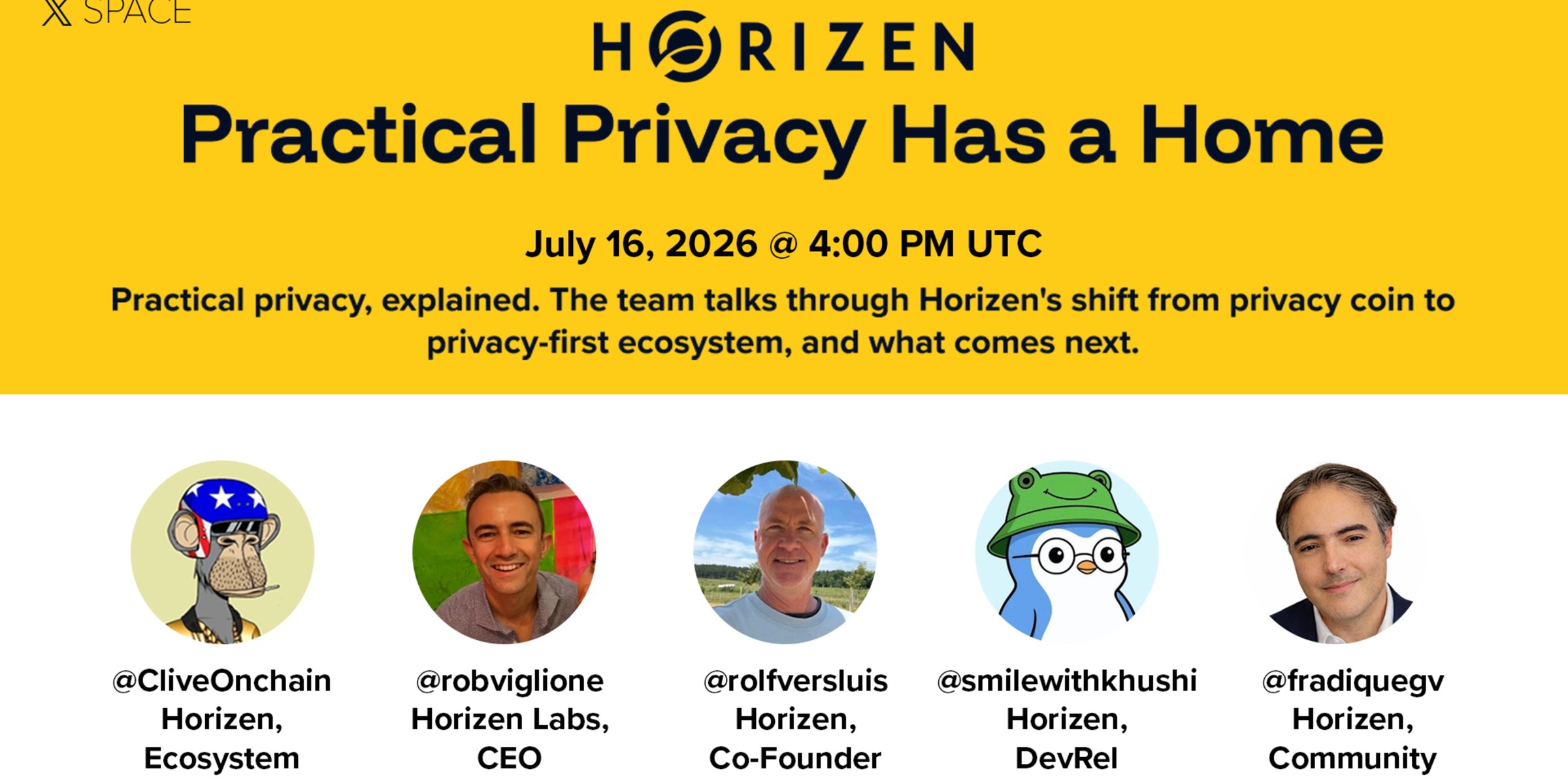
This week we hosted an X Space to talk through the ideas behind Part 1 of Practical Privacy Has a Home. Michael Patsko, Ecosystem Lead at Horizen, was joined by Rob Viglione, CEO of Horizen Labs, Rolf Versluis, co-founder of Horizen, Fradique from the community team, and Khushi Panwar from DevRel. For anyone who could not join live, here is a recap of the conversation. The recording is available to listen back.
Where Horizen started, and where it is now
Rolf opened by framing privacy through a business owner's lens. When you run a company, you protect what makes it work, from your customers and suppliers to your strategy. Traditional finance already strikes this balance. Banks keep your activity confidential from competitors while still disclosing to those with a legal right to see it. Blockchain inverted that by making activity public by default, which was workable while the space was experimental. Horizen's work is to bring that practical balance onchain while staying true to the original goal of building a more open and useful system.
Why EVM-native
Rob walked through the path that led here. Earlier iterations, including an EVM sidechain, did not find product-market fit. Moving to an EVM-native environment put Horizen where developers actually build, which matters because privacy needs to reach the applications people use, not just private store of value. Building alongside the Base ecosystem places Horizen close to a large developer community and deep liquidity, but Rob was clear that the point is not any single piece of technology. The point is making privacy practical enough that doing real things onchain becomes feasible.
The builder case: bring your own privacy
Khushi covered why Horizen is a friendly home for developers. The core idea is that you should not have to learn a new language to build with privacy. Developers can write Solidity, deploy with familiar frameworks like Hardhat and Foundry, and add privacy where their application actually needs it. Khushi called this "bring your own privacy." A team might reach for zero-knowledge proofs to prove something without revealing it, or confidential compute for sensitive work. zkVerify handles proof verification, Vela supports confidential compute, and teams can design their own patterns at the app level. Compliance sits alongside this as a toolkit rather than a constraint, with integrations like PureFi available for transaction-level checks.
She also flagged that new developer docs arrive next week, written to work well with AI coding tools, with a Horizen MCP server on the way.
Privacy and the agentic economy
Rolf shared how he has been building with AI agents, including a verified documents project that uses zero-knowledge proofs to confirm that what an AI returns genuinely comes from the source material. Pointing his agent at the Horizen docs, he was able to write, test, and deploy the supporting smart contract with low fees. His broader point was that agents move fast and do not mind extra steps like bridging, but they will want privacy so competing agents cannot front-run or copy their strategies. Between zero-knowledge proofs and secure enclaves, Horizen and Horizen Labs are building toward a natural home for that kind of activity.
Michael added that privacy is likely to be essential for agents precisely because they read machine-readable instructions and will happily operate in a private environment to protect what they are doing.
The role of ZEN
The conversation turned to ZEN. ZEN is no longer a privacy token. It is the coordination and value-routing token for the ecosystem, and it now exists as an omnichain token across Base and the Horizen L3. The mechanism for that role is the ZEN staking program, which is launching later this month and gives holders a way to signal alignment with the ecosystem. We will go deeper on ZEN and the economic engine in a dedicated conversation in the coming weeks as staking goes live.
What the team is watching
Fradique brought community questions to the stage, including which metrics signal that the thesis is working. The answer from Rob and Michael was consistent. The focus is on real usage. Quality applications, active users, and transaction volume matter more than total value locked. As more of the ecosystem comes online, including Zendex and additional protocols, transaction volume is the metric the team is watching most closely.
What comes next
A few things to look out for. New developer docs land next week. A second X Space focused on the builder case is coming, with ecosystem builders joining the stage to share why they chose Horizen and how they use its privacy tooling. Builder programs begin later in Q3, including work with partners in South America, and the team is building toward Devcon in Mumbai this November. The ZEN staking program goes live later this month, with a dedicated deep dive to follow.
Thanks to Rob, Rolf, Fradique, and Khushi for joining, and to everyone who listened in. If you missed the Space, the recording is available to listen back.